
Important security note: Warning of attempted fraud in the name of DWS
We have detected that fraudulent individuals are misusing the "DWS" trademark and the names of DWS employees on the internet and social media. These fraudsters are operating fake websites, Facebook pages, WhatsApp groups and Mobile Apps. Please be aware that DWS does not have any Facebook Ambassador profiles or WhatsApp chats. If you receive any unexpected calls, messages, or emails claiming to be from DWS, exercise caution and do not make any payments or disclose personal information. We encourage you to report any suspicious activity to info@dws.com, including any relevant documents and the original fraudulent email. Additionally, if you believe you have been a victim of fraud, please notify your local authorities and take steps to protect yourself.
Investment Traffic Lights
10/6/2026
The monthly Investment Traffic Lights provide a detailed market analysis and our view on developments in the main asset classes.
IN A NUTSHELL
- After a strong August, September proved more challenging for investors as a sharp rise in bond yields weighed on most risk assets.
- Despite the magnitude of the move in yields, equity markets held up relatively well, although performance was driven by only a handful of sectors.
- Investors enter the fourth quarter against a backdrop of persistently unsettled bond markets. Nevertheless, resilient corporate earnings, solid economic growth and the continued strength of the AI-driven capex cycle suggest that it may take a more fundamental regime shift in bond markets before equities come under sustained pressure.

Vincenzo Vedda
Chief Investment Officer

Page summary
1. Market overview
1.1 Geopolitical tensions and record high bond yields
What shaped markets in September? The month presented investors with a mixed picture. On the negative side, continued tensions in the Middle East pushed oil and even more so diesel prices higher, fueling inflation concerns and contributing to a sharp rise in government bond yields. Markets grappled with growing anxiety over the scope of further monetary tightening, renewed concerns about Europe’s fiscal outlook, particularly in France. At the same time a high-profile meeting between Trump and Xi failed to deliver any meaningful progress.
Against this backdrop, however, economic fundamentals remained surprisingly resilient. Sentiment indicators continued to improve, with the U.S. flash composite PMI reaching a five-year high, the Eurozone Purchasing Managers’ Index (PMI) a three-year high, and Japan’s Tankan survey showing its strongest reading since the early 1990s. 2Q26 gross domestic product (GDP) data for both Europe and the U.S. have been revised upwards. In addition, corporate earnings proved resilient and the artificial intelligence (AI) investment cycle continued unabated.
Given the sharp rise in bond yields, equities’ relatively modest decline is noteworthy, although performance was driven by a narrow group of sectors. Only 27% of stocks outperformed the MSCI AC World Index in September, and just two of ten sectors delivered positive returns, both linked to the AI ecosystem. In light of tightening financial conditions, the scale and structure of AI financing — record convertible issuance, jumbo junk bond deals and multi-trillion-dollar private valuations — alongside a growing debate about whether the capital being deployed can ultimately be justified by AI revenues was a dominant theme in September. Anthropic’s upcoming initial public offering (IPO) (the prospectus has already made the rounds) might help investors to better understand the monetization dynamics of this space.
1.2 High bond yields weigh on equities
The third quarter was marked by a broad repricing across global asset markets as rising inflation concerns, higher oil prices and renewed central-bank tightening expectations pushed bond yields sharply higher. Government bonds suffered their worst quarterly performance since 2024, with the Bloomberg Global Aggregate Index falling more than 2.5% in September alone. U.S. Treasury yields surged across the curve, led by maturities higher than 7 years, with the 10-year yield moving comfortably above 5% and the 30-year reaching its highest level since 2002. In Europe, Bund yields climbed above 3.5%, while concerns over France’s fiscal outlook triggered a significant widening in peripheral spreads. The French 10-year OAT-Bund spread widened to 127 basis points, its highest level since 2012, and the Italian-German spread rose above 100 basis points for the first time in more than a year.
Higher bond yields weighed on risk assets in September. Global equities declined 1.3%, retreating from record highs reached by both the S&P 500 and the Stoxx Europe 600 in August. Europe was the weakest-performing major region, while Japan and the United States proved more resilient. At the sector level, materials and diversified financials lagged, whereas AI-related themes continued to outperform, with strong gains in semiconductors, technology hardware and cybersecurity stocks. Currency and commodity markets reflected the same macro backdrop. The U.S. dollar recorded its strongest monthly performance since March, supported by higher U.S. yields and expectations of further Federal Reserve (Fed) tightening, while the euro fell to a 16-month low against the dollar. Meanwhile, Brent crude briefly surged above USD 108 per barrel as tensions surrounding the U.S.-Iran conflict disrupted flows through the Strait of Hormuz before easing back towards USD 100 by month-end. Gold, by contrast, declined as rising real yields increased the opportunity cost of holding non-yielding assets.
2. Outlook and changes
The fourth quarter in financial markets is likely to be shaped by two conflicting forces: high government bond yields on the one hand and robust economic momentum with continued earnings per share (EPS) growth on the other. While higher oil prices have often been cited as the main driver of higher bond yields, the increase has not been fueled by rising inflation expectations but by a rise in real yields. The coming month might shed more light on whether the yield rise has been triggered by improving economic expectations or doubts about fragile public debt profiles. As for profits, we are entering the third-quarter reporting season with higher expectations than in the second quarter, slightly increasing the risk of disappointment even if the numbers are good. Equities will need to show sufficiently broad earnings momentum to offset higher bond yields, which are normally a drag on most sector valuations.
2.1 Fixed Income
Let’s try to see the positive side of September having lifted rates so drastically: higher yields have created more attractive entry points in fixed-income markets, while resilient fundamentals continue to support credit. In foreign-exchange markets, the dollar’s strength is increasingly being challenged by longer-term trends towards global currency rebalancing. Nonetheless, the recent widening of European sovereign bond spreads warrants close attention. While waning confidence in France’s commitment to fiscal reform is unlikely to reverse in the near term, we believe fears of broader contagion across Europe are exaggerated.
Government Bonds
U.S. Treasuries remain attractive following the recent yield repricing, as we continue to see market expectations for Fed tightening as overly aggressive relative to our central economic outlook. Higher yields have improved valuations, while a slowdown in growth and easing inflationary pressures could provide support for both the front and long ends of the Treasury curve.
In Europe, government bond markets are experiencing heightened volatility. Alongside the global rise in yields, France’s fiscal situation has triggered a significant widening of spreads across many European government bonds relative to German Bunds, which have recently benefited further from safe-haven flows.[1] With markets remaining highly fluid, we are either staying on the sidelines and waiting for momentum to subside or adapting quickly to market moves where our conviction is sufficiently strong.
Part of the current market dynamics reflects shifting expectations for the European Central Bank (ECB). While we believe inflation data would have provided the central bank with a strong rationale to continue its tightening cycle, the sharp moves in bond markets, which are already contributing to tighter financial conditions, make an October rate hike unlikely in our view. We held a positive view on two- and ten-year Bunds at the yield levels seen in late September.[2] For Italian spreads, we have, for the time being, moved back to a Neutral, despite our constructive assessment of the underlying fundamentals, which appear broadly in line with those of its euro-area peers and continue to improve. Compared with the past, the Italian government has proven surprisingly stable. From a fiscal perspective, the debt-to-GDP ratio has stabilized at around 137%, growth is expected to remain below 1% in both 2026 and 2027, and inflation is projected to decline from 2.9% to 2.2% by 2027. Recent rating upgrades reflect a favorable assessment by credit rating agencies. However, higher borrowing costs could put pressure on future budgets. Idiosyncratic risks remain relatively limited, suggesting that most of the recent widening in spreads is being driven by broader risk aversion, the persistence of which remains uncertain.
As for French OATs, we remain Neutral. On the one hand, further spread widening cannot be ruled out given elevated political uncertainty. On the other hand, a significant amount of negative news now appears to be priced in. Moreover, French banks and insurers, traditionally viewed as natural domestic buyers of OATs, may see current yield levels as an attractive entry point. With risks and opportunities finely balanced, we see little justification for moving away from a neutral stance at this stage.
UK gilts remain attractive, as markets continue to price in a significantly more aggressive Bank of England tightening path than our central scenario. Elevated real yields and compelling valuations support a constructive stance, while a moderation in energy prices or weaker economic momentum could provide scope for yields to decline, particularly at the front end of the curve.
Corporate Bonds
We upgraded European Investment Grade credit to +1, not least because new issuance has been much lower than feared. Furthermore, Euro IG credit has become a carry asset class for many investors, offering low volatility, strong fundamentals and predictable supply. The asset class differs significantly, both fundamentally and technically, from the increasingly heated debate around government debt sustainability. Absolute yields have become a non-negligible investment argument for many investors, while continued inflows into the asset class from new pools of capital or reallocation decisions provide further support for IG credit. We expect buying momentum to increase further as rates volatility eases. We have also raised European High Yield to Neutral, following a market correction in September that led spreads to widen by around 50bps to 292bps. Coupled with the rise in rates, this resulted in one of the few months of materially negative total returns for the market. Our more constructive stance reflects improved valuations, our more positive economic and rates outlook, and still-solid technicals, as we continue to see buyers stepping in whenever the market weakens. However, we would still not move to +1, as we view periods of global monetary tightening as risky. Technicals could also suffer if new issuance increases. Valuations are still not attractive enough to fully compensate for these risks.
For both U.S. Investment Grade and High Yield credit, we remain Neutral, as resilient demand and still-healthy market fundamentals are balanced by headwinds from future supply by large technology issuers and still-relatively tight spreads.
Emerging Markets
Emerging Market sovereign debt continues to benefit from resilient growth, supportive commodity dynamics and positive rating trends across many countries. However, following a period of strong performance, valuations have become less compelling, prompting a more neutral stance despite the asset class’s still-favorable fundamental backdrop.
Currencies
EUR/USD remains supported by our constructive medium-term view on the euro, despite recent U.S. dollar strength driven by a more hawkish Fed and widening short-term rate differentials. With limited scope for further yield divergence and a still-cautious outlook for the dollar, the balance of factors continues to support a positive longer-term view on the euro. For USD/JPY, recent Fed-driven dollar strength has offset support for the yen from intervention and Bank of Japan developments. Nevertheless, USD/JPY is expected to remain below 160, reflecting a more balanced outlook for the currency pair going forward.
2.2 Equities
Based on the resilience of economic growth and corporate earnings, we remain constructive on equities, particularly as valuations have become more attractive during the third quarter. As Morgan Stanley noted, this has been the largest derating in a rising market in more than 30 years. In other words, although the MSCI AC World posted a modest gain during the quarter, its price-to-earnings (P/E) ratio declined by around 7%, as 12-month forward earnings estimates increased by more than 10%. In fact, every sector saw higher 12-month forward earnings estimates over the quarter for the first time in more than five years.[3]
While we see few reasons to expect a sudden slowdown in earnings growth, markets still face several headwinds heading into the fourth quarter. Above all, higher bond yields remain a concern. With 10-year Treasury yields trading above 5%, valuation pressure is increasingly affecting many parts of the market. September's performance illustrated this clearly: gains were driven almost entirely by technology-related sectors, with only Information Technology and Communication Services (which include several hyperscalers) delivering positive returns, while the remaining sectors ended the month in negative territory. Earnings growth must therefore continue to offset the drag from higher discount rates. Equally important, the AI investment cycle needs to remain largely intact, as it continues to be the dominant driver of market leadership. Consumer fatigue in the face of elevated energy prices is another risk we are monitoring closely.
We have not changed any of our regional views in recent months, Japan and European small- and mid-cap equities remain our only Outperform recommendations. Japan's recent strong Tankan survey, with business conditions across industries reaching their highest level since the early 1990s, combined with robust manufacturing activity supported by the AI-driven capital expenditures (capex) cycle, reinforces our positive stance. We also maintain our favorable view on European small and mid-caps, supported by the ongoing industrial recovery and historically attractive valuations.
At the sector level, banks remain one of our preferred exposures, benefiting from higher interest rates even if the yield curve flattens further. We also continue to favor utilities, where AI-driven electricity demand remains a powerful structural tailwind despite the headwind from higher yields. Within technology, we now take a broader approach after having concentrated on semiconductors in 1H26. We now see AI driving companies in the hardware, software and semiconductor segments alike. The broader rollout of AI agents[4] has provided another boost to the investment case. Finally, while we remain neutral on healthcare overall while appreciating its defensive characteristics within a diversified portfolio, biotechnology stands out as our preferred subsector, supported by sustained innovation and what we expect to be continued robust M&A activity. We have downgraded Consumer staples to Underweight as they are no longer the defensive haven they once were. Earnings revisions remain negative and pricing power continues to fade amid changing consumer preferences and tighter household budgets. With limited scope for margin expansion, demanding valuations, and only a handful of attractive stock opportunities, the sector's risk-reward profile has become less compelling. As a result, we downgrade staples to underweight, while continuing to favor select areas such as beverages and beauty, where pricing power and innovation remain supportive. We have upgraded global real estate from underweight to neutral as improving operating fundamentals across several property segments make a defensive underweight position less compelling. Limited new supply, driven by higher construction and financing costs, is supporting occupancy and rental growth, particularly in senior housing, industrial properties, data centers, and commercial real estate services. Attractive valuations, above-average earnings growth, and meaningful AI exposure through data center Real Estate Investment Trusts (REITs) are supportive, although the sector remains sensitive to higher interest rates and energy-driven inflation risks.
2.3 Alternatives
Gold
Rising U.S. Treasury yields and expectations of additional Federal Reserve rate hikes put renewed pressure on gold prices. Despite the pullback, gold exchange-traded fund (ETF) holdings increased by roughly 400,000 ounces in the third week of September, suggesting continued institutional buying interest. Retail demand, however, remains subdued, with both Indian and Chinese investors largely staying on the sidelines. We believe the spot price of gold could test USD 4,000 again. We anticipate that central bank demand will pick up at this price level and view USD 4,000 as a potential lower trading boundary for gold.
Oil
We have reduced our stance on oil from +1 to Neutral. In early September, Iran held an advantage in disrupting traffic through the Strait of Hormuz, while the Houthis in Yemen expanded their conflict with Saudi Arabia by taking over coastal cities on the Red Sea. The Houthis also temporarily halted oil flows through the East-West Pipeline. However, momentum has shifted in recent days. Under U.S. protection, nearly all Middle Eastern oil production, except Iranian oil, is now believed to be moving through the Strait of Hormuz. Traffic through the East-West Pipeline has also been restored, and Saudi Arabia is now able to resume oil deliveries via the Suez Canal. With the U.S. continuing to tighten its economic and physical blockade and oil now seemingly flowing freely through these chokepoints, the Iranian government faces a challenging dilemma: either engage militarily with the U.S. to defend its control of the Strait of Hormuz or accept U.S. conditions to reach a deal. However, we do not believe that a deal will be reached before the midterm elections.
3. Past performance of major financial assets
Total return of major financial assets year-to-date and past month
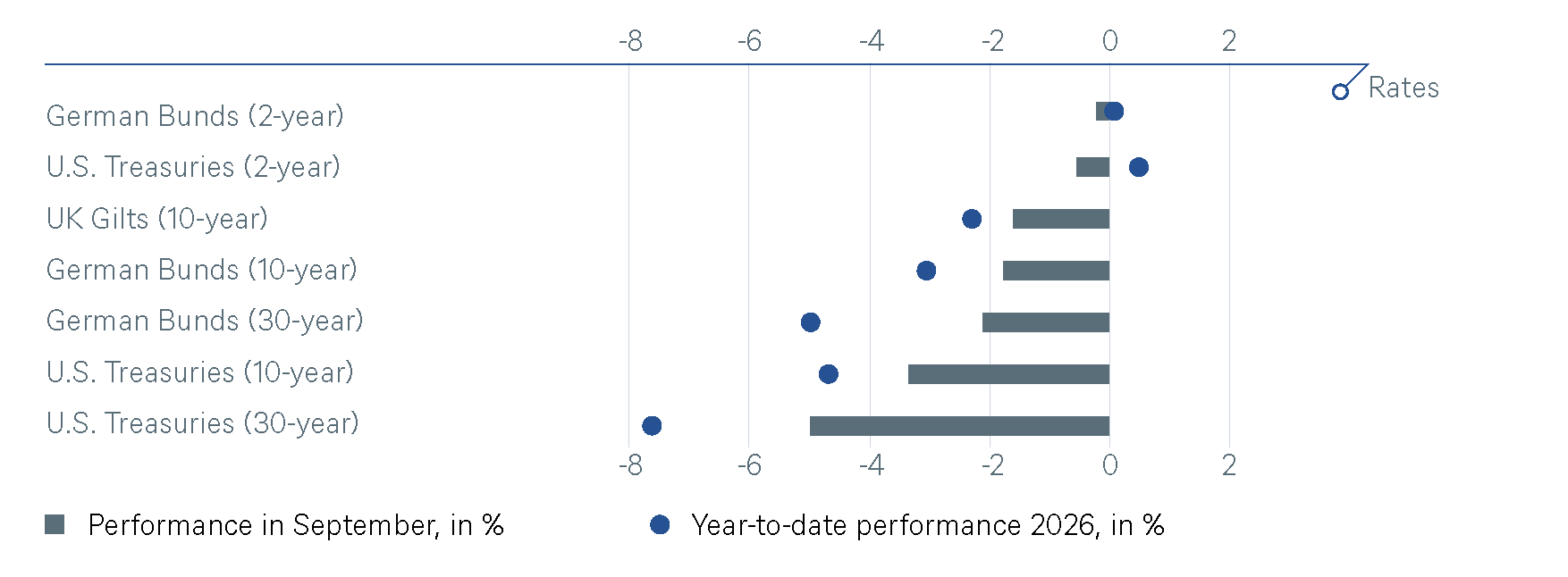


Past performance is not indicative of future returns. Sources: Bloomberg Finance L.P., DWS Investment GmbH as of 9/30/2026
4. Tactical and strategic signals
The following exhibit depicts our short-term and long-term positioning.
| Rates | 1 to 3 months | through September 2027 |
|---|---|---|
| U.S. 2yr Interest Rate |  |  |
| U.S. 10yr Interest Rate | | |
| U.S. 30yr Interest Rate | | |
| Germany 2yr Interest Rate | | |
| Germany 10yr Interest Rate | | |
| Germany 30yr Interest Rate | | |
| Japan 2yr Interest Rate | | |
| Japan 10yr Interest Rate | | |
| UK 2yr Interest Rate | | |
| UK 10yr Interest Rate | | |
| UK 30yr Interest Rate | | |
| Spreads | 1 to 3 months | through September 2027 |
| EUR IG Corp | | |
| U.S. IG Corp. | | |
| EUR HY Corp. | | |
| U.S. HY Corp. | | |
| EM Sovereigns | | |
| Italy 10yr[5] | | |
| Asia Credit | | |
Securitized / specialties | 1 to 3 months | through September 2027 |
| U.S. taxable municipal bonds[6] | | |
| Currencies | 1 to 3 months | through September 2027 |
| EUR vs. USD | | |
| USD vs. JPY |  | |
Legend:
Tactical view (1 to 3 months)
The focus of our tactical view for fixed income is on trends in bond prices.
Positive view
Neutral view
Negative view
Strategic view through September 2027
The focus of our strategic view for sovereign bonds is on bond prices.
For corporates, securitized/specialties and emerging-market bonds in U.S. dollars, the signals depict the option-adjusted spread over U.S. Treasuries. For bonds denominated in euros, the illustration depicts the spread in comparison with German Bunds. Both spread and sovereign-bond-yield trends influence the bond value. For investors seeking to profit only from spread trends, a hedge against changing interest rates may be a consideration.
The colors illustrate the return opportunities for long-only investors.
- Positive return potential for long-only investors
- Limited return opportunity as well as downside risk
- Negative return potential for long-only investors