
Important security note: Warning of attempted fraud in the name of DWS
We have detected that fraudulent individuals are misusing the "DWS" trademark and the names of DWS employees on the internet and social media. These fraudsters are operating fake websites, Facebook pages, WhatsApp groups and Mobile Apps. Please be aware that DWS does not have any Facebook Ambassador profiles or WhatsApp chats. If you receive any unexpected calls, messages, or emails claiming to be from DWS, exercise caution and do not make any payments or disclose personal information. We encourage you to report any suspicious activity to info@dws.com, including any relevant documents and the original fraudulent email. Additionally, if you believe you have been a victim of fraud, please notify your local authorities and take steps to protect yourself.
Europe’s gas stores tell only half the story
9/4/2026
A changing gas market may be making gas storage levels a less reliable guide to winter risks. Still, there are good reasons to worry about upcoming heating bills.

A few years ago, Europe’s policymakers hatched a cunning plan: replace lost Russian pipeline gas by expanding the continent’s capacity to import liquefied natural gas (LNG) from around the world. Unlike most plans in the British comedy classic Blackadder, this one has largely worked. But the coming winter may reveal some less comfortable consequences.
As our Chart of the Week shows, European gas storage levels remain well below those seen at the same point in recent years. Taken at face value, that looks alarming. Storage was, after all, one of Europe’s principal lines of defense during the energy crisis. But the significance of low storage has changed.
Before Russia’s full-scale invasion of Ukraine in 2022, Europe sourced most of its gas through long-term contracts and pipelines. Today, its LNG terminals allow it to buy gas more flexibly throughout the year. That has reduced, though not eliminated, the need to accumulate large inventories months in advance. But that flexibility comes at a price: in the global LNG market, supplies and prices depend more heavily on demand elsewhere, disrupted shipping routes, outages at export facilities and weather patterns. Alongside storage, the global market has become a second insurance policy, albeit one with a variable premium.
Weather adds another layer of uncertainty. Recent heat waves across the Northern Hemisphere have boosted electricity demand and intensified competition for LNG. A mild winter in major consuming regions, by contrast, could curb heating demand and make more LNG available to other buyers. Europe’s low storage levels would look considerably less threatening. In an extreme scenario, today’s fears of scarcity could turn into tomorrow’s problem of plenty.
“Recent months are starting to illustrate some of the trade-offs of a more global market for gas supplies,” argues Johannes Müller, Chief Economist. “Europe’s gas market has become more flexible, but also more exposed to global competition. If Europe must bid aggressively for LNG this winter, the effects will be felt far beyond its shores.”
Lower inventories may not imply the same degree of risk as they did several years ago. In Blackadder, Baldrick would have appreciated the irony: Europe’s cunning plan worked, but with an unintended side effect. Gas that can reach Europe more easily can just as easily sail elsewhere.
Low storage no longer tells the entire story
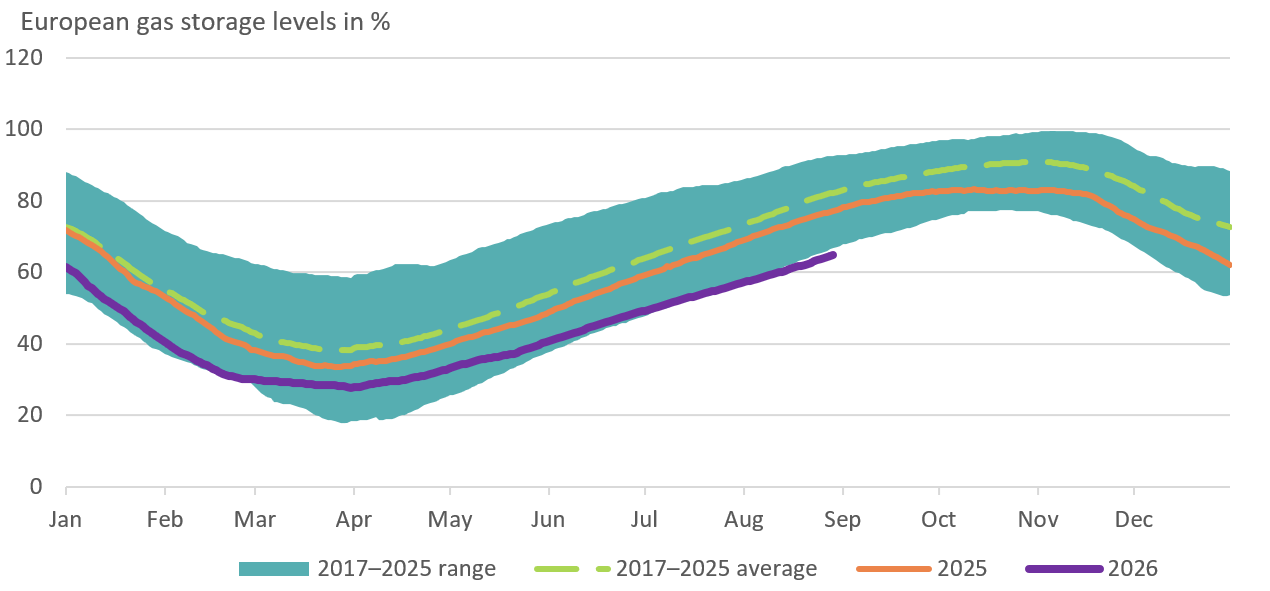
Sources: Gas Infrastructure Europe (AGSI); DWS Investment GmbH calculations as of 09/01/26
Storage filling levels are expressed as a percentage of working gas volume. The shaded area represents the daily minimum-to-maximum range observed between 2017 and 2025, while the dashed line shows the corresponding historical average. The 2026 series is shown through the latest available observation.
This information is subject to change at any time, based upon economic, market and other considerations and should not be construed as a recommendation. Past performance is not indicative of future returns. Forecasts are based on assumptions, estimates, opinions and hypothetical models that may prove to be incorrect. Alternative investments may be speculative and involve significant risks including illiquidity, heightened potential for loss and lack of transparency. Alternatives are not suitable for all clients.