
Important security note: Warning of attempted fraud in the name of DWS
We have detected that fraudulent individuals are misusing the "DWS" trademark and the names of DWS employees on the internet and social media. These fraudsters are operating fake websites, Facebook pages, WhatsApp groups and Mobile Apps. Please be aware that DWS does not have any Facebook Ambassador profiles or WhatsApp chats. If you receive any unexpected calls, messages, or emails claiming to be from DWS, exercise caution and do not make any payments or disclose personal information. We encourage you to report any suspicious activity to info@dws.com, including any relevant documents and the original fraudulent email. Additionally, if you believe you have been a victim of fraud, please notify your local authorities and take steps to protect yourself.
APAC CIO View
03/09/2026
Status Quo of Artificial Intelligence (AI) Adoption in Asia
IN A NUTSHELL
- AI adoption across Asia-Pacific has been uneven, with Singapore leading the region, followed by Australia, Korea, and Taiwan, while Japan, India, and China appear relatively behind today.
- Improving local-language LLM performance is quickly lowering adoption barriers in non-English speaking markets such as Korea, Taiwan, and Japan, reducing the gap with English-speaking or highly bilingual markets like Singapore and Australia.
- Government policy is a critical adoption accelerator, especially where it expands compute capacity, funds AI infrastructure and gives enterprises clear incentives to embed AI into workflows.
- Future AI adoption will depend increasingly on public and private-sector investment capacity, with globally competitive, well-capitalized companies likely to adopt fastest, while lower-income or slower-transforming markets may need stronger public investment or foreign capital to close the gap.

Ivy-sw Ng
APAC Chief Investment Officer

Tommy Law
Analyst

Investor attention has largely focused on AI model development and the infrastructure supply chain required to support it, from semiconductors and data centers to cloud platforms and power. However, the adoption and deployment of AI are equally important. Ultimately, the economic impact of AI will depend not only on advances in model capability and compute capacity, but also on how effectively enterprises, governments, and consumers integrate AI into daily workflows. This essay provides a brief assessment of the current state of AI adoption across selected Asia-Pacific markets, as well as the key factors driving differences in adoption across countries.
Figure 1: Global AI Diffusion Score - Selected APAC Countries: 1H25 - 1Q26
 Source: Microsoft, as of May 7, 2026
Status Quo
AI adoption across Asia-Pacific remains uneven (Figure 1). Singapore stands out as the clear regional leader, supported by strong digital infrastructure, a coordinated national AI strategy, and a highly internationalized business environment. Australia, Korea, and Taiwan are close followers, with adoption supported by relatively advanced enterprise digitization, strong public-sector backing, and industry-specific use cases. Japan, India, and China appear to be relative laggards today, though for different reasons. Japan is catching up quickly as corporate adoption accelerates, while India and China have substantial long-term potential given their large domestic markets, deep talent pools, and significant base effects.
Large Language Model (LLM) Performance Improves in Asia Local Language
One important driver of this divergence is the availability and usability of frontier AI models in local languages. The Massive Multitask Language Understanding (MMLU) benchmark and its multilingual extension are useful measures of LLM performance across languages (Figure 2). Historically, LLMs have performed better in English than in many Asia-Pacific languages because the vast majority of the training data is English centric. This has supported faster adoption in English-speaking or highly bilingual markets such as Singapore and Australia. More recently, however, improvements in the non-English capabilities of newly released models have made AI tools increasingly useful for everyday enterprise and consumer workflows in markets such as Korea, Taiwan, and Japan. This improvement in local language capability is helping reduce one of the key barriers to adoption and is likely one reason these markets are now catching up.
Figure 2: Multilingual Performance of ChatGPT Models Across Selected APAC Languages, as Measured by the Massive Multitask Language Understanding (MMLU) Benchmark
 Source: Microsoft, as of May 7, 2026.
Government Support Promotes AI Use Cases and Infrastructure Buildout
Another factor behind the divergence in AI adoption is government support, particularly where policy is used to promote both practical use cases and infrastructure buildout.
Singapore is a clear example of a government-led AI adoption model. Publishing its 1st National AI Strategy in 2019 and a National AI Strategy 2.0 in 2023, Singapore has one of the earliest and most coordinated efforts in driving AI adoption across industry and government, developing talent, strengthening data governance, and securing compute capacity.[1] The government has also committed more than S$1 billion over five years to AI compute, talent, and industry development, including up to S$500 million for high-performance computing resources. A forward-thinking government policy framework appears to be one of the biggest drivers that differentiate Singapore from the rest of the world in the AI adoption race.
Korea and Taiwan provide strong evidence that government policy can leverage the existing competitive advantage to accelerate adoption. In its National AI Strategy Policy published in 2024, Korea aims to be among the top three AI country globally (i.e. AI G3) and has set explicit targets for 70% AI adoption in industry and 95% adoption in the public sector by 2030, while also expanding General Purpose Unit (GPU) capacity, establishing a National AI Computing Center, and mobilizing Korean Won (KRW) 65tn of private-sector AI investment from 2024–2027.[2] Taiwan is similarly using government support to convert its semiconductor advantage into broader AI adoption through GPU access for startups, AI training-data repositories, public-sector AI training, New Taiwanese Dollar (NT$) 10bn of AI startup funding, and a target to increase national computing power to 1,200 petaflops by 2029.[3] These examples suggest that government support can materially accelerate adoption by lowering infrastructure constraints, creating demand through public-sector deployment, and giving enterprises clearer incentives to invest in AI-enabled workflows.
Japan’s support for AI is now part of a broader shift in fiscal and industrial policy. Under the 2026 Basic Policy on Economic and Fiscal Management and Reform and Japan’s Growth Strategy, the government is moving away from single-year budget constraints toward a multi-year investment framework designed to address chronic underinvestment, strengthen supply capacity and attract private capital into 17 strategic sectors.[4] The road map envisages more than Japanese Yen (JPY) 370tn of cumulative public- and private-sector investment through fiscal 2040, with AI and semiconductors the largest priority at around JPY102tn.[5] This includes approximately JPY68tn for semiconductors, JPY23.1tn for vertical AI and JPY10.5tn for physical AI. The second AI Basic Plan complements this fiscal framework by promoting AI adoption across government and industry, strengthening domestic compute, data and power infrastructure, and supporting sector-specific and physical-AI applications. Rather than a stand-alone technology subsidy, AI investment is therefore a central pillar of Japan’s wider reform agenda to raise productivity, ease labour shortages and restore industrial competitiveness. However, the headline figures represent targeted combined public-private investment rather than committed government spending alone.
Private Market Led Investment
Private-sector investment is also a key enabler of AI adoption, but the level of adoption varies meaningfully by country depending on both willingness and ability to invest.
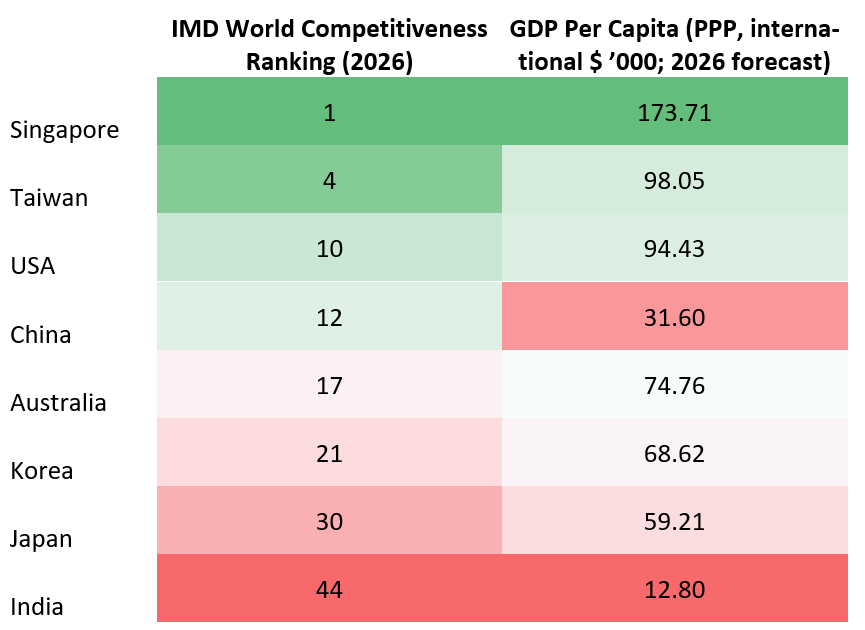
Willingness to invest is largely a function of private-sector competitiveness. In markets where corporates face greater competitive pressure — either domestically or globally — firms have stronger incentives to adopt AI to improve productivity, defend market share, and out-compete peers (Figure 3). Ability to invest is driven by the financial resources available to the private sector, for which Gross Domestic Product (GDP) per capita can serve as a broad proxy (Figure 3). Countries with higher income levels generally have greater capacity to fund enterprise technology upgrades, cloud migration, talent acquisition, and AI infrastructure.
Examples across Asian markets broadly support this framework. Singapore illustrates the strongest combination of willingness and ability, with high-income corporates in globally competitive sectors such as finance, logistics, telecom, and aviation adopting AI to protect productivity and service quality. Australia’s adoption is supported by broad-based investment capacity, high labor costs, and a mature enterprise IT environment. Korea and Taiwan are driven by globally competitive private sectors, particularly in semiconductors, electronics, batteries, and advanced manufacturing, where firms have strong incentives to adopt AI to protect productivity and global market share.
India shows that strong willingness among leading firms may not translate into broad-based AI diffusion when economy-wide investment capacity remains limited, as reflected by its lower GDP per capita and 44th ranking in the 2026 IMD World Competitiveness Ranking. China presents a different profile: despite its lower GDP per capita, it ranks 12th, ahead of Australia, Korea, Japan and India. This points to relatively strong economy-wide competitiveness and capacity to invest in strategic industries, although AI adoption may remain uneven between leading firms in internet, electric vehicles, robotics and advanced manufacturing and the broader corporate sector. Microsoft-based diffusion measures may also understate activity taking place through China’s domestic AI and cloud ecosystems.
Figure 3: Competitiveness and PPP-adjusted GDP Per Capita Across Selected Markets (2026)
Source: International Monetary Fund, World Economic Outlook Database (April 2026 vintage; 2026 forecasts); IMD World Competitiveness Ranking 2026, covering 70 economies. Data accessed August 4, 2026.
Implications
So far, AI adoption across Asian countries has varied significantly. One important factor behind this divergence has been the weaker performance of large language models in many local Asian languages compared with English, which has limited the immediate usefulness of AI tools in some markets. However, as model performance across languages continues to converge, access to capable LLMs should become a less important differentiator for AI adoption in Asia.
Going forward, the pace of AI adoption is likely to be driven more by public- and private-sector investment. Large companies operating in globally competitive industries, with the financial resources to out-invest smaller peers, are likely to be relative winners as they can move faster in deploying AI to improve productivity, reduce costs, and defend market share. For lagging countries seeking to close the adoption gap, they may need to rely more heavily on outsized public-sector investment or attract foreign direct investment with their scale advantage to offset weaker private-sector investment capacity. This could include funding for AI infrastructure, digital skills, cloud adoption, public-sector AI use cases, and incentives for enterprise adoption.