
Important security note: Warning of attempted fraud in the name of DWS
We have detected that fraudulent individuals are misusing the "DWS" trademark and the names of DWS employees on the internet and social media. These fraudsters are operating fake websites, Facebook pages, WhatsApp groups and Mobile Apps. Please be aware that DWS does not have any Facebook Ambassador profiles or WhatsApp chats. If you receive any unexpected calls, messages, or emails claiming to be from DWS, exercise caution and do not make any payments or disclose personal information. We encourage you to report any suspicious activity to info@dws.com, including any relevant documents and the original fraudulent email. Additionally, if you believe you have been a victim of fraud, please notify your local authorities and take steps to protect yourself.
The Fed’s next move is no longer obvious
11/09/2026
Economists expect gradual cuts. Markets see a less comfortable possibility: resilient growth and persistent inflation could force the Fed to raise rates again.

Among its many attractions, Disney’s animated classic, The Lion King, offers a useful guide to U.S. monetary policy: what looks like the end of one cycle may be the start of another. After several rate cuts, the U.S. Federal Reserve (Fed) now faces resilient growth and persistent inflation. Until recently, investors mainly worried that weaker growth would force further rate cuts. Now they must consider the risk of renewed hikes too.
As our Chart of the Week shows, economists’ forecasts and market pricing point to different paths for interest rates. The Bloomberg consensus among economists points to gradual cuts through 2027. Rates implied by SOFR futures initially move in the opposite direction, rising above 4% before falling again. These prices are not pure forecasts. They should also reflect the investors’ desire to insure against surprises. Even so, the contrast is striking. Economists expect inflationary pressures to ease steadily. Markets place more weight on the possibility that the Fed will have to reverse course.
At first glance, the mechanism appears straightforward. A robust economy can reduce the need for precautionary rate cuts intended to counter a possible downturn. Persistent inflation, meanwhile, keeps renewed hikes in play. But why do economists and markets interpret the same data so differently? One reason may be the Fed’s more limited guidance. Without clearer signals from the central bank, individual data releases can shift market expectations more sharply than before. This interpretation is consistent with research indicating that uncertainty about future policy rates affects asset prices independently of monetary-policy surprises.[1]
Economists, by contrast, must separate the signal from the noise in volatile, frequently revised data. The latest employment report provides a good example. “At first glance, stronger hiring may sound like hakuna matata: no reason to worry,” notes Christian Scherrmann, Chief U.S. Economist at DWS. “Yet the report mainly reduced downside risks without adding to domestic price pressure as wages remain moderate. With inflation still affected by energy prices and tariffs, the next inflation report should tell us more about whether higher rates are warranted.”
We view the latest figures as neither a case of hakuna matata nor a clear signal for renewed tightening. Much as in the circle of life, there is more to discover in the data than any single release can reveal. With Fed guidance scarce, each new clue could send markets down a different path.
Markets see a greater risk of renewed Fed hikes
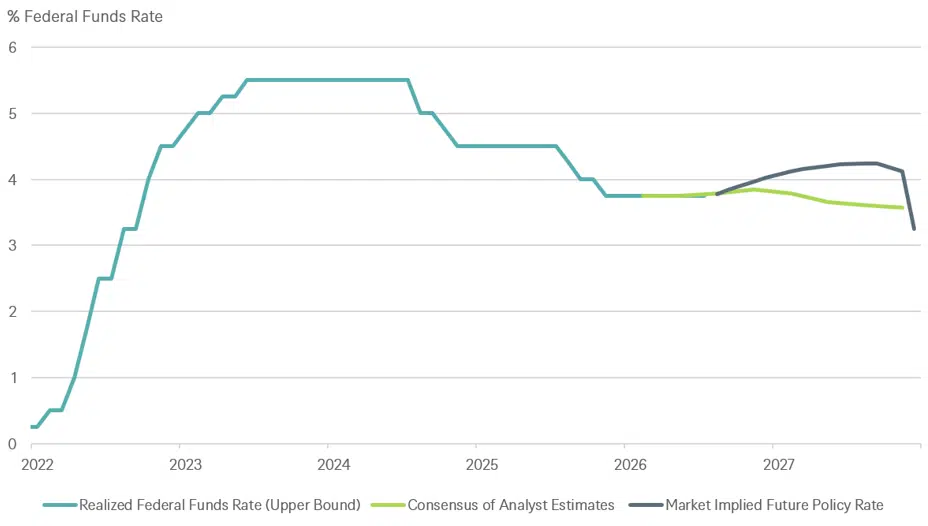
Sources: Bloomberg Finance L.P.; DWS Investment GmbH as of 09/08/26
This information is subject to change at any time, based upon economic, market and other considerations and should not be construed as a recommendation. Past performance is not indicative of future returns. Forecasts are based on assumptions, estimates, opinions and hypothetical models that may prove to be incorrect. Alternative investments may be speculative and involve significant risks including illiquidity, heightened potential for loss and lack of transparency. Alternatives are not suitable for all clients.