

Warning – attempted fraud
We have detected that fraudulent individuals are misusing the "DWS" trademark and the names of DWS employees on the internet and social media. These fraudsters are operating fake websites, Facebook pages, WhatsApp groups and Mobile Apps. Please be aware that DWS does not have any Facebook Ambassador profiles or WhatsApp chats. If you receive any unexpected calls, messages, or emails claiming to be from DWS, exercise caution and do not make any payments or disclose personal information. We encourage you to report any suspicious activity to info@dws.com, including any relevant documents and the original fraudulent email. Additionally, if you believe you have been a victim of fraud, please notify your local authorities and take steps to protect yourself.
7/3/2025
The DAX has hit a record high, outperforming smaller German stocks. Investors expect a business-friendly government. But many challenges remain.

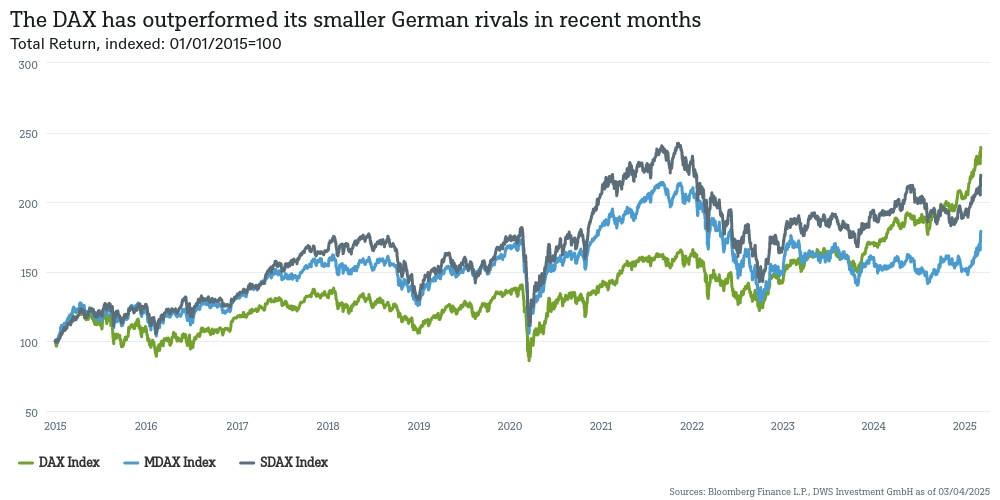
In recent decades European stocks, especially the German benchmark index DAX, have rarely outperformed their U.S. counterparts. Even rarer have been the periods, in which the DAX has also outperformed its domestic mid-cap and small-cap competitors MDAX and SDAX.[1]
And yet, the total returns for the DAX, which just set a new record high, currently exceed those of the SDAX, which is unusual indeed, as the chart for the past 10 years shows. To explain all this, it helps to have a closer look at what these indices actually contain.
During the past three months, the strong performance of individual DAX heavyweights has played a central role. Companies such as SAP, Rheinmetall, Siemens and Deutsche Telekom have contributed significantly to the rise in the index. SAP benefited from the growing demand for Artificial Intelligence (A.I.) and cloud solutions, while defense companies have been boosted by increasing defense spending. These themes played less of a role in the German small- and midcap segments.[2]
The DAX may also have benefited from a shift by investors away from the U.S. market. U.S. tech stocks reached high valuations last year amidst much technology-related excitement, while European blue chips remained comparatively cheap. Now, however, investors could be nervous about U.S. valuations and economic prospects under Donald Trump. Meanwhile, the European Central Bank (ECB) has further supported European markets by cutting interest rates, making equities more attractive relative to traditional savings products and, over time, easing companies’ interest burden.
The election victory of the Christian Democratic Union (CDU/CSU) under party leader Friedrich Merz in February has also had a positive impact on German stocks. Especially the domestically focused equities in the MDAX have reacted most positively. Overall, there seems to be relief that another unwieldy three-party coalition has been avoided and investors hope that a business-friendly government could raise defense spending and investment in infrastructure.[3] However, we believe that there might be a good chance that much of this hope is already priced into German stocks.
All economic and financial data – unless otherwise stated – from Bloomberg Finance L.P. as of 3/4/25
Any mentions of specific securities are for illustrative purposes only and should not be considered a recommendation.
For more details, see https://www.dws.com/insights/cio-view/cio-flash/cwf-2025/not-quite-a-sweeping-mandate/
This information is subject to change at any time, based upon economic, market and other considerations and should not be construed as a recommendation. Past performance is not indicative of future returns. Forecasts are based on assumptions, estimates, opinions and hypothetical models that may prove to be incorrect. Alternative investments may be speculative and involve significant risks including illiquidity, heightened potential for loss and lack of transparency. Alternatives are not suitable for all clients.
DWS is the brand name of DWS Group GmbH & Co. KGaA and its subsidiaries under which they do business. The DWS legal entities offering products or services are specified in the relevant documentation. DWS, through DWS Group GmbH & Co. KGaA, its affiliated companies and its officers and employees (collectively “DWS”) are communicating this document in good faith and on the following basis.
This document is for information/discussion purposes only and does not constitute an offer, recommendation or solicitation to conclude a transaction and should not be treated as investment advice.
This document is intended to be a marketing communication, not a financial analysis. Accordingly, it may not comply with legal obligations requiring the impartiality of financial analysis or prohibiting trading prior to the publication of a financial analysis.
This document contains forward looking statements. Forward looking statements include, but are not limited to assumptions, estimates, projections, opinions, models and hypothetical performance analysis. No representation or warranty is made by DWS as to the reasonableness or completeness of such forward looking statements. Past performance is no guarantee of future results.
The information contained in this document is obtained from sources believed to be reliable. DWS does not guarantee the accuracy, completeness or fairness of such information. All third party data is copyrighted by and proprietary to the provider. DWS has no obligation to update, modify or amend this document or to otherwise notify the recipient in the event that any matter stated herein, or any opinion, projection, forecast or estimate set forth herein, changes or subsequently becomes inaccurate.
Investments are subject to various risks. Detailed information on risks is contained in the relevant offering documents.
No liability for any error or omission is accepted by DWS. Opinions and estimates may be changed without notice and involve a number of assumptions which may not prove valid.
DWS does not give taxation or legal advice.
This document may not be reproduced or circulated without DWS’s written authority.
This document is not directed to, or intended for distribution to or use by, any person or entity who is a citizen or resident of or located in any locality, state, country or other jurisdiction, including the United States, where such distribution, publication, availability or use would be contrary to law or regulation or which would subject DWS to any registration or licensing requirement within such jurisdiction not currently met within such jurisdiction. Persons into whose possession this document may come are required to inform themselves of, and to observe, such restrictions.
For institutional / professional investors in Taiwan:
This document is distributed to professional investors only and not others. Investing involves risk. The value of an investment and the income from it will fluctuate and investors may not get back the principal invested. Past performance is not indicative of future performance. This is a marketing communication. It is for informational purposes only. This document does not constitute investment advice or a recommendation to buy, sell or hold any security and shall not be deemed an offer to sell or a solicitation of an offer to buy any security. The views and opinions expressed herein, which are subject to change without notice, are those of the issuer or its affiliated companies at the time of publication. Certain data used are derived from various sources believed to be reliable, but the accuracy or completeness of the data is not guaranteed and no liability is assumed for any direct or consequential losses arising from their use. The duplication, publication, extraction or transmission of the contents, irrespective of the form, is not permitted.
© 2025 DWS Investment GmbH
Issued in the UK by DWS Investments UK Limited which is authorised and regulated in the UK by the Financial Conduct Authority.
© 2025 DWS Investments UK Limited
In Hong Kong, this document is issued by DWS Investments Hong Kong Limited. The content of this document has not been reviewed by the Securities and Futures Commission.
© 2025 DWS Investments Hong Kong Limited
In Singapore, this document is issued by DWS Investments Singapore Limited. The content of this document has not been reviewed by the Monetary Authority of Singapore.
© 2025 DWS Investments Singapore Limited
In Australia, this document is issued by DWS Investments Australia Limited (ABN: 52 074 599 401) (AFSL 499640). The content of this document has not been reviewed by the Australian Securities and Investments Commission.
© 2025 DWS Investments Australia Limited

Institutional Investor
Please read the following Important Information and then click the appropriate option box below.
This Australian website is operated by DWS Investments Australia Limited ABN 52 074 599 401 (“DWS Australia”).
DWS Australia is a company incorporated under the laws of the Australian Capital Territory, Australia with its principal place of business in Australia at Level 16, 126 Phillip Street, Sydney, New South Wales 2000 Australia. DWS Australia is the holder of Australian Financial Services Licence No. 499640. DWS Australia is an asset management subsidiary of DWS Group GmbH & Co. KGaA (“DWS Group”).
DWS Australia is not an Authorised Deposit-taking Institution under the Banking Act 1959 nor regulated by APRA.
Your use of this Australian website (“website”) is subject to this Important Information, the Terms of Use, our Privacy Statement and any other terms, conditions, notices or disclaimers displayed on the website (Website Terms”). If you do not agree to these terms, then do not use this site.
By using the website you will be deemed to accept the Website Terms and agree to be bound by them.
Access to the information contained on this website is intended solely for persons in Australia who are wholesale clients as defined in section 761G of the Corporations Act and who are accessing this website from within Australia. If you are not resident in Australia, please do not use this website. You must not distribute or pass on information on this website, which is intended solely for wholesale clients, to any person who is not a wholesale client.
This website does not constitute an offer or solicitation and is not directed at you if DWS Australia is prohibited by any law of any jurisdiction from making the information on this website available to you and is not intended for any use that would be contrary to local law or regulation. No products and services mentioned on this website must be promoted in any jurisdiction where this would not be permitted.
This website is not aimed at any US Person (as defined by Regulation S of the US Securities Act 1933) and is not to be used by persons in the United States or US Persons. It does not constitute an offer to sell or solicitation of an offer to buy, or an invitation to subscribe for or buy securities in the United States. By accessing this website, you represent, warrant and agree that you are not a US Person, a resident of the US, currently located in the US or a person acting on account of a US Person.
This website does not constitute investment, legal or tax advice with respect to products or services and it is important that you do not rely on its content when making an investment decision. The information on this website is general information only and does not take into account your individual objectives, financial situation or needs. No recommendation or advice is being given as to whether any investment or strategy referred to on this website is suitable for you. You should obtain relevant and specific professional advice before making any decision to enter into an investment transaction. DWS Australia will not treat users of the website as its clients by virtue of them accessing it.
Past performance is not indicative of future results. The value of investment funds and the income therefrom may go down as well as up and you may not get back the original amount invested. Your capital could be at risk. Exchange rates may cause the value of overseas investments and the income therefrom to rise and fall. DWS Australia does not guarantee any particular rate or return, the performance of any investment or the repayment of capital from any investment.
DWS Australia does not represent that the information on this website, including any third party information, is accurate or complete and it should not be relied upon as such. Certain information contained on this website (including any forward-looking statements and economic and market information) has been obtained from published sources and/or prepared by third parties and may not be current. While such sources are believed to be reliable, DWS Australia, each of its officers, employees and affiliates do not assume any responsibility for the accuracy or completeness of such information. Any views or opinions expressed may not reflect those of DWS Australia, or any of its officers, employees and affiliates as a whole.
The information expressed on this website is subject to change without notice.
Your Use of the Website
You must NOT use the website (or permit or procure others to use it) as follows:
When using the website, you must comply with all applicable local, national and international laws and regulations, including those related to data privacy, international communications and exportation of technical or personal data. It may be illegal to download the information contained on the website in certain countries and we and our affiliated companies disclaim all responsibility if you download any information from the website in breach of any law or regulation of the country in which you reside.
We may, in our absolute discretion, and without any liability or giving any reason to you, terminate, suspend or restrict your access or use of part or all of the website if we consider that you have breached any of the Website Terms or if we otherwise consider it necessary in order for the proper functioning of the website.
All copyright and other intellectual property rights subsisting in this website (including all content on this website) is owned by DWS Australia or our affiliates or licensors. You may not reproduce (in whole or in part), transmit (by electronic means or otherwise), modify, link into or use for any public or commercial purpose the website (including any content on the website) without the prior written permission of DWS Australia.
Nothing on this website should be construed as granting any licence or right in relation to any of our trademarks or those of our affiliated companies or any third party.
You grant to DWS Australia, a non-exclusive, irrevocable, perpetual, worldwide, royalty-free, transferable licence to use, reproduce, modify, adapt, publish or communicate to the public all information you provide to us for the reasonable purposes of our business and to permit third parties to do those things for us. You consent to any act or omission that would otherwise infringe any of your rights (including your moral rights) in information you provide to us.
You warrant that you have the right to grant the above licence, that our exercise of the licence rights will not infringe the rights (including intellectual property rights) of any person and does not breach any law.
The website, including information and materials contained in the website, text, graphics, software, links and other items are provided "as is" and/or "as available". DWS Australia does not warrant the accuracy, adequacy, completeness, timeliness or availability of the website, and expressly disclaims liability for errors or omissions in the website. To the maximum extent permitted by law, DWS Australia expressly disclaims any implied statutory guarantees and any express or implied warranties of any kind, including any warranties of merchantability, fitness for a particular purpose or non-infringement in conjunction with the website.
To the maximum extent permitted by law, DWS Australia and each of its officers, employees and affiliates, excludes all liability for any damages, including, without limitation, direct or indirect, special, incidental, or consequential damages, losses or expenses arising in connection with the website or use thereof or the inability by any party to use such website, or in connection with any failure of performance, error, omission, interruption, defect, delay in operation or transmission, computer virus or line or system failure, even if DWS Australia, or representatives thereof, are advised of the possibility of such damages, losses or expenses. You release and discharge DWS Australia and each of its officers, employees and affiliates from and against any and all liabilities suffered or incurred by you as a result of your use of this website or any investment decision by any person made in reliance of any information sourced from this website.
Hypertext links to other internet websites or materials prepared by third-parties (’links’) are included as a convenience for our visitors. Certain hypertext links on the website may lead you to websites that are not under the control or charge of DWS Australia.
DWS Australia is not responsible and assumes no liability for the content of any linked websites and materials prepared by third-parties, including, without limitation, the accuracy, subject matter, quality or timeliness of the content of such linked external websites or materials. The fact that such links have been provided does not constitute an endorsement, authorization, sponsorship by or affiliation with DWS Australia with respect to any linked website or material or their sponsor or author. There are risks in using any information, software or product accessed on the Internet and we urge you to make sure you understand these risks before doing so.
By entering this website, you acknowledge and agree that DWS may place cookies on the device via which you access the site. These cookies are either to give us anonymised data about your use of the website. This includes details such as the website from which you accessed our website, the duration of your visit and the pages you viewed. Such information, which will not include your name, helps us improve the performance and content of our websites. You can block or delete cookies from your computer - simply refer to the help function of your browser.
Any personal data which might be collected when visiting this website will be processed in accordance with applicable data protection law. DWS Australia is committed to maintaining the privacy of any personal data it holds about you and does so in accordance with the Australian Privacy Principles contained in the Privacy Act 1988. Please read our Privacy Policy to understand how your personal information will be treated when you use this website.
This website shall be governed by, and your browsing in and use of this website shall be deemed acceptance of, the laws of New South Wales, Australia. A condition of using this website is that in the event of any dispute or proceeding you irrevocably submit to the exclusive jurisdiction of the courts of New South Wales, Australia and waive any objection to proceedings in such courts on the grounds of venue or on the grounds that the proceedings have been brought in an inconvenient forum.
DWS Australia may revise the Website Terms at any time by publishing an updated version on the website. You are expected to check the Website Terms from time to time to take notice of any changes DWS Australia makes, as they are binding on you. If any provision of these Website Terms is deemed unlawful, void, or unenforceable, then that provision will be deemed severable from these Website Terms and will not affect the validity and enforceability of the remaining provisions.
Each time you use this website, you will be deemed to accept the then current Website Terms and agree to be bound by them.
CONFIRMATION
* I confirm I have read the Important Information set out above and accept its contents shall be governed by the laws of New South Wales, Australia.
* I confirm that I am a Wholesale Client that is resident in Australia and who is accessing this website from within Australia.
* I confirm that I am not a US Person, a resident of the US, currently located in the US or a person acting on account of a US Person.
* I accept and agree to be bound by the current Website Terms.
We use cookies and similar technologies that are essential to operate our websites. With your consent, we will use cookies for performance analysis of our websites. This enables us to detect and fix errors and usability issues as soon as possible and to constantly improve our website. Furthermore we use marketing cookies to measure the success of our marketing measures and personalize our contents to your needs as precisely as possible, potentially also outside of our websites. In the settings you can find detailed information on the different types of cookies and object to the use of cookies. As an asset manager, the security of your data is highest priority to us. You can find further information in our privacy notice.


